

The following article by freelance writer Tony Hicks is made possible through the financial support of paid subscribers and other donors to the newsletter. Please consider becoming a paid subscriber, if not already, to support more local news coverage of Martinez.
By Tony Hicks
The city of Martinez is considering the creation of an “entertainment zone” to attract more people, and their spending money, to the downtown area.
The state made it legal in 2024 for cities to establish entertainment zones, where people 21 and over can legally possess and drink open alcoholic beverages outdoors from local, licensed businesses within the designated zones during specified events, days and times.
San Francisco was the first to do so, with cities including Walnut Creek, Auburn, Long Beach, Redding, Sacramento, San Jose, Santa Monica and Suisun City following the trend, which frequently involves live entertainment, food and other attractions. Each city sets its own rules on when its entertainment zone is “activated,” whether for specific pre-approved events or during designated days and times. Martinez’s draft ordinance allows for the proposed entertainment zone to be activated for alcohol consumption in outdoor public spaces and common areas within the zone only for events where a special event permit is issued by the Community and Recreation Services Division and a safety and security plan is approved by the police department.
The City Council’s Economic Development Subcommittee showed enthusiasm for the idea at its June 22 meeting in the Council Chamber, before approving sending the staff recommendation to the City Council.
Associate city planner Salmana Shah presented the plan to subcommittee and City Council members Satinder S. Malhi and Jay Howard.
“Entertainment zones are a proven tool to help revitalize cities’ commercial spaces through safe and vibrant events,” Shah said “They help attract tourism, support local business, and foster economic growth.”
The proposed zone wouldn’t differ much from other downtown events when streets are usually blocked to vehicle traffic.
With police input, the proposed entertainment zone would extend from just beyond Buckley Street and Marina Vista Avenue to the north, to Court Street to the east, to Green Street to the south, to Berrellesa Street to the west.
The zone wouldn’t include any parts of the city zoned residential.
Businesses couldn’t deliver beverages to patrons, who would need wristbands after they show ID proving they’re 21 and over, before buying a to-go container (non-metal, non-glass container, branded or not) from an establishment.
The event organizer — usually the city, Downtown Martinez and Co. or the Martinez Chamber of Commerce — would provide insurance. In all cases, the insurance must cover the city.
Businesses would have to notify the state Alcoholic Beverage Commission (ABC) of intent to participate in the zone every year. Businesses could only sell to-go drinks during event hours, and outside drinks wouldn’t be allowed. Nor would taking alcohol outside the designated zone.
Non-participating businesses inside the zone can exclude patrons carrying alcohol from entering. Organizers would have to submit a waste-diversion plan to the city, and the event would be subject to the city’s noise control ordinance.
Michael P. Cass, the city’s assistant community and economic development director, told the subcommittee the zone would largely be used by businesses that already host events where alcohol is provided.
“What this really does is create an opportunity where the brick-and-mortar businesses in that general area, they would be the businesses selling the alcohol predominantly, rather than an outside vendor coming in for a special event,” Cass said.
Howard asked how businesses would prevent overserving.
Sarah Baird, the executive director of Downtown Martinez & Co., said anyone serving alcohol at a downtown event — even temporary workers — must go through the ABC’s Responsible Beverage Service (RBS) training.
“Businesses feel safe and educated when handling those people (who drink too much),” Baird said. “So if any town is prepared to handle an entertainment zone, I would say it’s us.”
Baird said downtown businesses support the idea, even those not selling alcohol.
“The main point of the entertainment zone is to encourage actual exploration around the zone or, in our case, it would be the downtown footprint,” Baird said. “So beyond Main Street, beyond right on the plaza.”
She said the zone would enable businesses to collaborate and get people to move, and spend, around downtown.
“If you don’t give reasons to move around, people will just find a spot and stay,” she said. “It’s like when you host a party at your house, if you don’t intentionally move people out of the kitchen, they won’t ever leave the kitchen.”
Malhi asked whether events in an entertainment zone would put additional burden on the city’s Public Works Department, which he said is already stretched thin.
Cass said the event’s sponsor would be responsible for cleaning up afterward and having a plan before the event. He said the city’s sustainability division is working with Downtown Martinez and Co. to have large ClearStream recycling receptacles available during events.
“This wouldn’t be any different than any other event that we apply for,” Baird said. “When we apply for the special event, we have to provide a trash plan, a recycling plan.”
Malhi also asked what city staff has learned from other cities doing entertainment zones.
“What’s really interesting is that the jurisdictions I did speak to, I received overwhelmingly positive feedback about the program,” Shah said. “I did specifically ask all of them if there are any lessons learned or anything they would do differently. I think because they’re all within the really early stages of their entertainment zone, they stated that it’s going really well with the measures that they have implemented.”
Cities indicated they didn’t have any safety or security issues, beyond what they normally have with bars and restaurants that serve alcohol, she said.
Cass said the biggest surprise he took from conversations with other cities was that the absence of crime and other problems in entertainment zones carry over to other times.
“So San Francisco as an example — they’ve seen decrease in crime in their entertainment zone areas even when there’s not that activation,” Cass said. “And that was a huge surprise.”
Baird said the zones speak to the need for community spaces.
“Post pandemic, we’re finding people are more isolated than ever, and they’re looking for things that don’t necessarily cost money,” Baird said. “So while an entertainment zone absolutely encourages economic vitality, it’s also providing a space for people.
“We’re creating spaces that encourage comfortable gathering and safe spaces for kids to play while their parents have a beer or they order a pizza, or they run across the street to a boutique and purchase something,” Baird said. “It’s creating a sense of community, belonging and something that people are going to want to help us take care of.”
Event organizers would likely take care of staff and security and signage letting people know when they’re passing the zone’s border and no alcohol is allowed. Cass said it depends on the size of the event.
“It’s going to depend upon each event,” Cass said. “Smaller events are going to have less of a presence. Large events will probably have somebody stationed at every ingress and egress point to the zone. It’s really going to depend upon the number of people, the number of businesses that are participating, and what other activities are going on. This is something the police department really emphasized. They want a plan with flexibility because each event does have unique issues and unique circumstances that have to be addressed.”
Cass responded to Malhi’s concern that the public might think the zone was all about alcohol consumption by pointing out activity examples in the staff report.
“We’ve included some examples of what could be done to activate the space,” Cass said. “Some of those events may include performances by musical groups, bands and DJs, theater performances, outdoor movies, comedy shows, open mic nights, farmers’ markets, night markets, street fairs, cultural festivals, holiday celebrations, art walks, food and wine festivals, car shows, makers markets, sports tournaments, watch parties for major sporting events, fitness events, dance classes, trivia nights, children’s activity zones, face painting, seasonal ice skating, and other activities and games.
“So we really are trying to get some creative things out there,” Cass said.
The subcommittee’s recommendation will likely go to the City Council in August. Cass said if everything works out, the entertainment zone could be in effect before the end of the year.
Public meeting scheduled Wednesday on refinery audit
By Craig Lazzeretti and Tom Lochner
A public meeting will be held Wednesday, July 1 to discuss the full-facility audit that was recently performed on PBF Energy’s Martinez refinery. The meeting will be held from 5 to 7 p.m. at the Hazardous Materials Programs Office, Alhambra Room, located at 4005 Port Chicago Highway in Concord. People can also attend the meeting via Zoom by registering at the following link: https://zoom.us/webinar/register/WN_ixyAbiRKTSW12UIT7Jlq4g#/registration
Consultant Eastern Research Group (ERG) conducted the “Full Facility Audit and Management Systems Evaluation” on behalf of Contra Costa Health and the Contra Costa Fire Protection District. The audit was requested in the wake of the major refinery fire on Feb. 1, 2025 that burned out of control for hours, causing significant damage to the refinery and triggering a shelter-in-place advisory for nearby residents. The fire followed a number of other refinery incidents dating to a major spent catalyst release that started on Thanksgiving night in 2022.
The county’s Martinez Refining Co. (MRC) Oversight Committee received a presentation of the draft audit report in May. The evaluation, according to a PowerPoint presentation by a four-person ERG team of experts delivered at the meeting, primarily comprises:
An overall review of the management systems in place at MRC to manage process safety; and
An assessment of the effectiveness of process safety programs at MRC, with the aim to develop recommendations to improve process safety management
The ERG consultant team, consisting of chemical engineers Anthony Gaglione, Brook McKeown, Sarah Biscardi and Zachary Good, came up with 31 findings and made some 41 recommendations that focus on the following concepts, according to the PowerPoint:
Oversight, auditing and quality assurance of management systems;
Evaluation of staffing levels
Opportunities to review and ensure accuracy and clarity of policies and procedures
A 45-day public comment period on the audit reported opened June 23 and closes on Aug. 7. People may make comments on the draft report at Wednesday’s public meeting and/or by emailing CalARP@cccfpd.org. Comments may also be mailed to the address below:
Contra Costa Health Hazardous Materials Programs
4005 Port Chicago Highway, Suite 120
Concord, CA 94520
Attn: Michael Dossey
‘Mayor for a Day’ steals show at Council meeting
By Craig Lazzeretti
At its last meeting before recessing for July, the City Council passed a fiscal year 2026-27 budget on Wednesday and wrapped up a number of routine business items. But it was “Mayor for a Day” Lydia Anne Whitwill who stole the show.
The recent fifth-grade graduate from Las Juntas Elementary School got to wield the ceremonial gavel on the dais seated next to Mayor Brianne Zorn. Each year, Zorn picks a local youth to serve as Mayor for a Day and help run a council meeting.
But Lydia did much more than simply read agenda items and take cues from Zorn. She also peppered staff and other presenters with probing questions and comments on various agenda items throughout the meeting, from wildfire hazard mitigation to the city’s urban water use plan to the proposed entertainment zone (mentioned earlier in this post), and seemed to build at least one political alliance along the way.
For example, during a discussion about the water plan that included the fact that the city delivers some of its water to unincorporated areas and Pleasant Hill properties, Lydia asked, “So I was wondering, if we’re selling water to Pleasant Hill people, how is that helping us?”
Councilman Greg Young, who had broached the issue more delicately earlier in the discussion, quickly chimed in, “That’s exactly what I wanted to add. I think you did a great job. You made it clear.”
The city attorney explained that the money received from the water sold to Pleasant Hill helps to fund improvements to Martinez’s water infrastructure. Added Public Works Director Joe Enke: “It just works geographically and engineering wise that our system is best able to serve them. And the rates are set so that they basically cover the cost of providing the service.”
Lydia and Young teamed up again during a later agenda item about the city’s OPEB (Other Post-Employment Benefits) Trust fund, which the council approved drawing $1.2 million from to help close a $2.2 million budget deficit. During the discussion, Young observed that there appeared to be a lack of awareness among city staff about how much the fund balance had grown over the years.
“I’m just kind of bewildered by … blindly contributing to something but you don’t know what the full balance is,” Young said. “That’s my own issue, I guess.”
Lydia made it her issue as well. “I just want to say, Councilmember Young, I don’t think you’re wrong to say what you’re saying. I kind of think you’re correct. I think that’s a good observation.”
To which Young replied: “Wow, thank you. I think you’re one of the first council members that have ever validated me like that. Feels good.”
Perhaps the highlight of the Mayor for a Day’s contributions came during a brief update by Howard at the end of the meeting about the Economic Development Subcommittee’s recent discussion on the proposed entertainment zone that would allow for outdoor consumption of open containers of alcohol.
Lydia zeroed in a topic of concern that has circulated among some community members since the idea was proposed.
“What I’m worried about is if some people walk through there and then some people did end up drunk by accident, would these people be in danger if people just wanted to walk through there?"
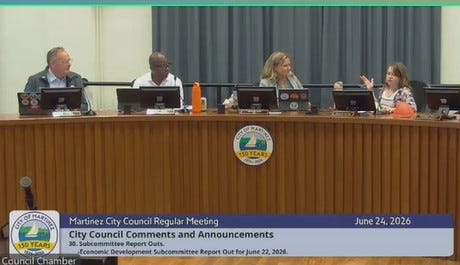
Mayor for a Day Lydia Anne Whitwill, far right, asks a question about the proposed downtown entertainment zone.
“That’s a very good question,” Howard acknowledged, adding that city officials had the same concern but found that it had not become a problem in their research of other cities with such zones. He then handed off the topic to police Captain Ben Alldritt, who was sitting in for Chief Andrew White.
“Any adult that chooses to consume alcohol and be out in public has a responsibility to do it safely,” he said. “We have found that historically we have a lot of success with these types of things. But we’re definitely there, and we’ll definitely come out if you need us.”
After asking for further clarification about where and how adults would obtain the alcoholic beverages, Lydia shared that she initially had a very different idea about what the proposed zone would entail.
“I want to admit, when you first said entertainment zone, I thought like bounce houses, zip lines, like this is a place for kids. I was, like, wait, alcohol? This is not a place for kids.”
She got no debate from the council on that point.
Sounds to me like we should invite Lydia to Council Meetings more often. She’s a very astute young lady for a fifth (sixth?) grader! Thanks…